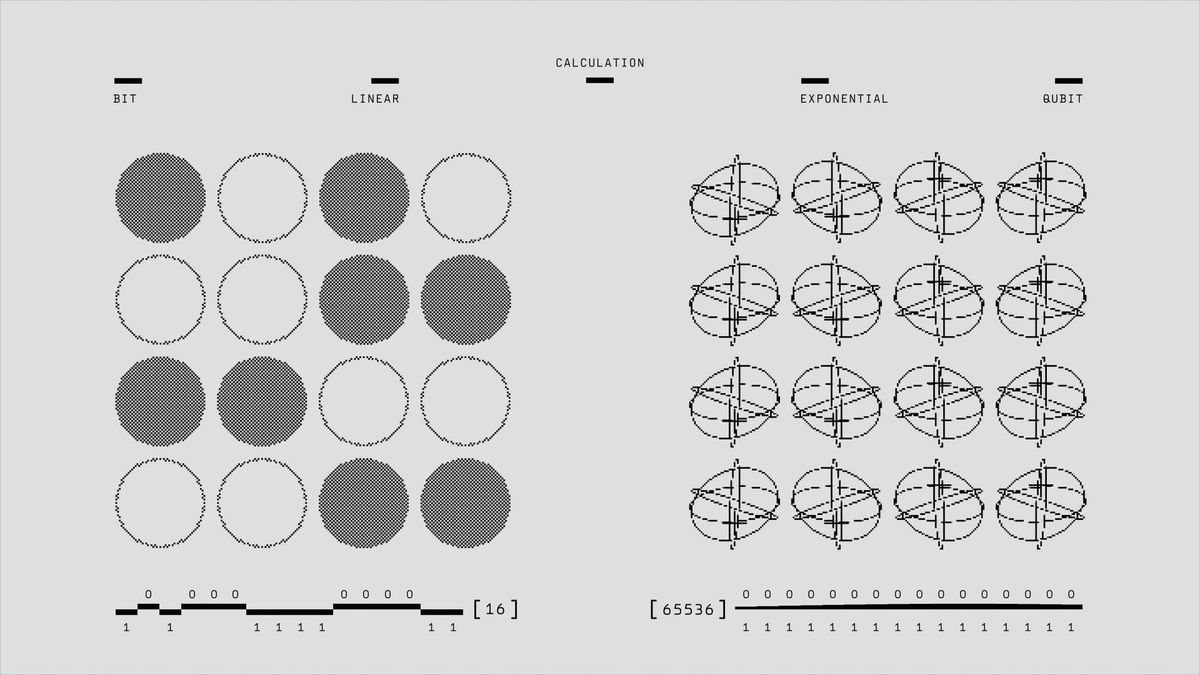
A quantum computer is often described as a machine that will be faster than today’s supercomputers. That comparison is understandable, but it is also misleading. A quantum processor is not a general-purpose upgrade in the way a faster chip or a larger server cluster is. It is a specialized device that represents and transforms information according to quantum physics, which can make a narrow set of calculations fundamentally different.
The practical question, then, is not “Which machine is more powerful?” It is: “What structure does this problem have, and can a quantum algorithm exploit it?” Supercomputers remain extraordinarily capable at weather prediction, fluid dynamics, artificial intelligence, engineering simulation, and the countless numerical tasks that make modern science work. Quantum computers may eventually become valuable partners when a problem’s quantum behavior or mathematical structure makes classical representation prohibitively expensive.
A question of representation
Classical computers, including the largest supercomputers, store information in bits. At any instant, each bit has a definite value: 0 or 1. Their enormous strength comes from combining immense numbers of reliable bits with advanced algorithms, fast memory, and parallel processors. A weather model, for example, breaks the atmosphere into a vast grid and repeatedly calculates changes in temperature, pressure, moisture, and wind at each location.
Quantum computers use qubits. A qubit can be prepared in a quantum state that combines the possibilities associated with 0 and 1, and multiple qubits can become entangled: their states must be described together rather than independently. This gives a quantum system a much larger mathematical state space than an equal number of ordinary bits.
That distinction is especially relevant when the thing being modeled is itself quantum mechanical. Molecules, magnetic materials, and certain interacting particle systems are made of quantum components. A classical computer can simulate them, but the amount of information needed can grow very quickly as the system becomes more complex. A quantum processor does not magically know the answer, but it can encode quantum behavior in a form closer to the physical system being studied.
Superposition is not mass parallelism
The popular shorthand says a quantum computer tries every answer at once. It captures a hint of the mathematics, then encourages the wrong mental model. A quantum state can contain amplitudes associated with many possible outcomes, but measuring it produces only a limited result. You cannot simply inspect every branch and keep the best answer.
The usable resource is interference. A quantum algorithm must arrange its operations so that paths associated with helpful outcomes reinforce one another while paths associated with unhelpful outcomes cancel. This is why quantum computing is an algorithmic discipline, not merely unusual hardware. If researchers cannot devise a circuit and measurement strategy that turns superposition into a useful statistical signal, the vast state space does not translate into an advantage.
A database search illustrates the limit. It is tempting to imagine that a quantum computer could instantly scan every entry in an unsorted list. But a well-known quantum search algorithm offers a square-root reduction in the number of checks under specific assumptions, not an effortless one-step lookup. For ordinary searches, databases, web browsing, spreadsheets, and most business software, classical methods remain the sensible tool.
A molecule makes the contrast concrete
Consider a team investigating a catalyst that might lower the energy needed for an industrial chemical reaction. The central challenge is to predict how electrons distribute themselves around atoms and how that distribution changes during a reaction. Electrons interact quantum mechanically; their possible configurations proliferate as the system grows.
A classical supercomputer can use carefully chosen approximations to calculate useful properties of many molecules. Those approximations are not a failure—they are the reason computational chemistry has become so productive. But some chemically important cases, especially where electrons are strongly correlated, are difficult to model accurately without computational costs rising sharply.
In a future hybrid workflow, a supercomputer could prepare the molecular geometry, select an active region, optimize parameters, and analyze results. The quantum processor would run the limited subroutine designed to estimate a difficult quantum property, perhaps an energy difference relevant to a reaction pathway. The classical system would then decide what calculation to run next. The quantum machine is not replacing the supercomputer; it is being used like a specialized scientific instrument attached to one.
- Classical computing remains essential for data preparation, control, optimization, error decoding, and result analysis.
- A quantum processor is most plausible where the hard part of the task maps naturally to a quantum system or a rigorously favorable quantum algorithm.
- A faster result matters only if its accuracy is sufficient for the scientific or engineering decision at hand.
The error-correction tax
The obstacle is not only building more qubits. Qubits are delicate. Stray electromagnetic effects, imperfect control signals, temperature changes, and other disturbances can alter a quantum state. Because useful quantum algorithms may require long sequences of operations, small physical errors can accumulate until the answer is unreliable.
Classical computers also experience errors, but their bits are stable enough that ordinary redundancy and error checking are comparatively inexpensive. Quantum error correction is harder because directly measuring a qubit generally disrupts the quantum information one wants to preserve. Instead, systems repeatedly measure carefully designed checks on groups of qubits and use those measurements to infer likely errors without reading the encoded computation itself.
The consequence is a large overhead. Many physical qubits may be needed to create one more reliable logical qubit, plus control hardware and fast classical processing to interpret error signals. Recent experiments have shown important progress: error-corrected logical qubits can outperform their component qubits under particular conditions. But that milestone is not the same as possessing a large, fault-tolerant computer able to run every promised application. The distinction matters because raw qubit counts alone say little about the size of a dependable calculation.
Benchmarks versus useful work
A quantum processor can outperform a classical machine on a carefully designed benchmark and still have no immediate commercial or scientific advantage. That is not necessarily a contradiction. Demonstration tasks can test whether hardware explores a regime that is difficult for classical simulation, while useful tasks must also produce answers that are accurate, verifiable, timely, and better than the strongest available classical alternative.
The moving target is crucial. Classical algorithms improve in response to quantum claims. Researchers have repeatedly found better ways to simulate certain quantum circuits or exploit special structure in an apparently hard benchmark. A credible claim of practical advantage therefore needs a fair comparison: the same problem, relevant accuracy, realistic input and output costs, and state-of-the-art classical methods—not an outdated baseline.
Optimization is an important unresolved case. Scheduling, routing, and resource allocation are often mentioned as near-term quantum applications because their search spaces can be immense. Yet many of these problems already have excellent classical heuristics, and no general proof says quantum computers will beat them in realistic settings. The right standard is not whether a quantum approach finds an answer, but whether it improves a decision enough to justify the hardware, engineering, and workflow costs.
From rivalry to a computing division of labor
The most useful way to follow quantum computing is to stop treating it as a race for a single universal champion. Supercomputers excel when a problem can be decomposed, approximated, and numerically processed with reliable classical bits. Quantum processors may add value when a carefully defined core calculation has structure that makes a quantum representation unusually efficient.
For readers evaluating a headline or a research announcement, three questions cut through much of the confusion. First, what exact task was performed? Second, was the comparison made against the best relevant classical method? Third, does the result address a meaningful scientific or operational outcome, rather than only an artificial benchmark?
This division of labor also explains why quantum progress is closely tied to classical computing rather than opposed to it. Future quantum systems will need classical computers to compile circuits, calibrate hardware, decode error-correction signals, orchestrate experiments, and interpret outputs. If quantum computing becomes broadly useful, its most likely form is not a replacement for the supercomputer, but a new component in a larger scientific computing system.
Final thoughts
Quantum computers and supercomputers differ less in headline speed than in what they can represent efficiently. A quantum processor offers no shortcut for every difficult problem, and its fragility imposes a severe engineering cost. But for selected calculations—especially those rooted in quantum physics—it could eventually make previously impractical simulations more accessible.
The enduring lesson is methodological: extraordinary hardware needs an equally specific algorithm and a fair classical comparison. Until those three pieces align, “quantum advantage” is best understood as a research result to examine closely, not a blanket verdict on the future of computing.
Sources
Photo by Google DeepMind on Pexels.