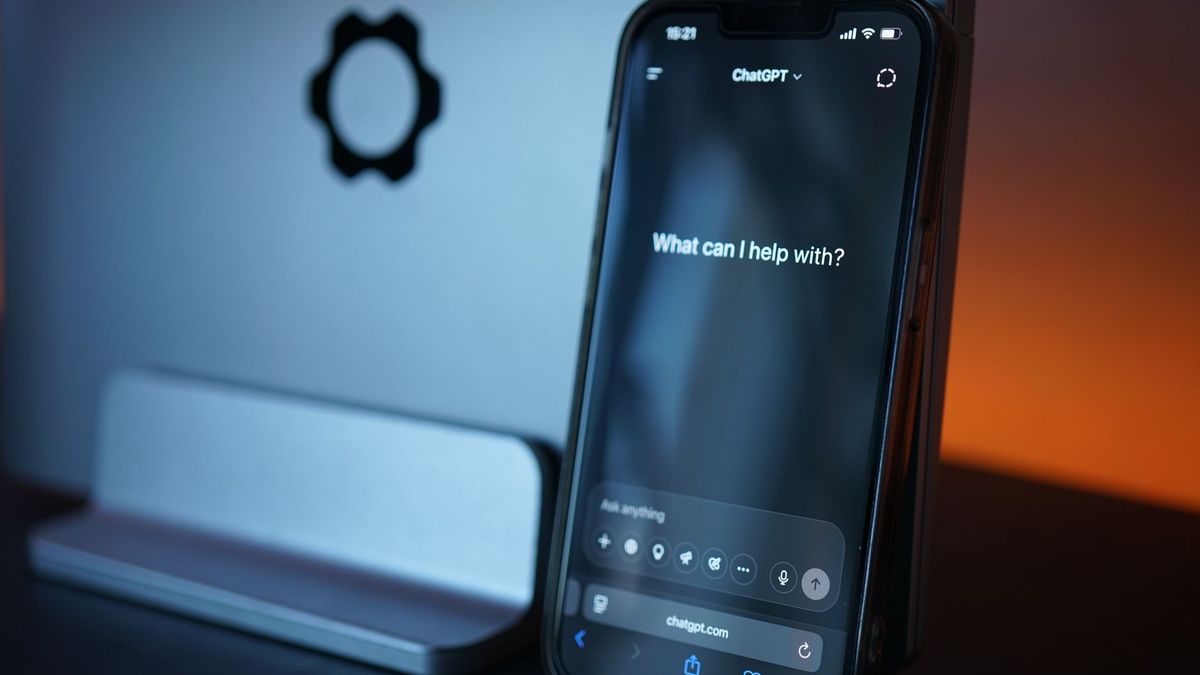
A growing number of AI features no longer begin by sending your request to a distant data center. They begin inside the device in your hand: a phone, laptop, earbud case, camera, or car. This is called on-device AI, meaning that the model performs its inference—the work of turning an input into an output—locally rather than relying entirely on an internet connection.
That shift sounds like a simple privacy upgrade. It is more consequential than that, and less absolute. Running AI locally changes the speed, reliability, cost, and design of a feature. It also imposes hard limits on model size, memory, battery use, and the kinds of questions a device can answer well. The useful question is not whether local AI is categorically better than cloud AI. It is which parts of a task benefit from staying nearby, and which still need the scale of a server.
Inference moves closer to the input
Most everyday AI is inference, not training. Training is the long, resource-intensive process of adjusting a model using immense collections of examples. Inference is the shorter moment when a finished model receives a photo, sentence, sound clip, or sensor reading and produces a result.
In a cloud-first design, a device packages the input, sends it over a network, waits for a remote model, and receives an answer. With on-device AI, the input can be processed in local memory by the phone’s main processor, graphics processor, or a dedicated neural processing unit (NPU). Modern devices increasingly have such specialized hardware because many machine-learning operations repeat the same kinds of matrix calculations.
This does not mean the entire application becomes local. A camera app might identify text in a viewfinder locally, while a generative assistant uses a server for a difficult request. Apple’s current developer documentation describes this division plainly: its local model is suited to offline work, while its Private Cloud Compute option offers a larger context window and stronger reasoning. The industry direction is not a clean replacement of cloud AI, but a routing decision between local and remote resources.
- Local inference: the device processes an input with a model already stored on, or downloaded to, the device.
- Cloud inference: the device sends an input to a remote service that runs the model.
- Hybrid inference: software selects a local or remote model based on the task, device capability, connection, or policy.
The practical gains are immediate—but task-specific
The most obvious local advantage is responsiveness. A live camera feature cannot comfortably wait for a network round trip on every frame. Similarly, autocorrect, noise suppression during a call, wake-word detection, keyboard suggestions, and document scanning feel better when they react continuously. Google’s ML Kit documentation emphasizes that local processing can support real-time camera uses and keep working offline.
Consider a traveler using a phone to translate a restaurant menu in a subway station. Optical character recognition can first find the text in the camera image locally. A local translation model can then produce a usable rendering without sending every frame of the menu over a weak connection. That is not merely faster; it changes the feature from “available when conditions cooperate” to “available at the moment it is needed.”
Local processing can also reduce the amount of raw material that must leave a device. A speech feature may turn audio into text locally; a photo feature may classify images locally; a health or smart-home feature may summarize sensor data before sharing anything. Keeping an input local is especially meaningful when it is highly personal or arrives as a continuous stream.
Yet speed is not automatic. A large local model can take time to load, compete with other apps for memory, or slow down when a device warms up. On-device AI is often excellent for bounded, repeated jobs. It is not magic acceleration for every request.
Privacy improves at one boundary, not all boundaries
“Runs on your device” is a valuable description, but it is not a complete privacy policy. It tells you something important about the inference step: the underlying input need not be transmitted to a model provider for that particular computation. It does not, by itself, tell you what the app collects elsewhere, whether outputs are synced, whether diagnostic data is retained, or what data was used to train the model.
Nor does local computation eliminate security risks. A device can be lost, compromised, or shared with another person. A model can still make an incorrect or biased prediction. And a local feature may invoke online tools, search, backups, or third-party services after its initial analysis. The boundary to inspect is therefore not the phone versus the cloud in the abstract, but the full path of a specific request.
This is where hybrid designs deserve scrutiny rather than blanket suspicion. Apple’s Private Cloud Compute is an example of a system designed for requests that exceed the local model’s capacity. Apple says its devices can determine whether a request can stay local and otherwise use encrypted, stateless server processing with technical mechanisms intended to make the software environment externally inspectable. Those claims are specific architectural commitments, not a general property of all cloud AI.
For users, the takeaway is simple: local AI can reduce exposure, but it cannot substitute for reading an app’s permissions, data-use disclosures, and controls. “On-device” should be treated as one favorable fact about a feature—not as a privacy verdict.
Small models make deliberate trade-offs
A phone has nowhere near the memory, cooling, or electrical budget of a data center. To fit useful AI into that environment, developers choose smaller models, compress model weights, reduce numerical precision, limit the amount of prior conversation the model can consider, and distribute work across specialized chips.
Quantization is a useful example. Models commonly store numbers with high precision. Reducing the precision can substantially shrink a model and make it cheaper to run, but may also slightly change its output. Other techniques remove less-important model components or train a compact model to imitate a larger one. These are not shortcuts around physics; they are negotiated trade-offs among speed, size, battery demand, and quality.
Research on mobile language-model deployment consistently identifies memory and energy as central constraints. The challenge becomes sharper for long conversations. A generative model needs working memory not just for its stored parameters but also for the growing record of tokens it has already processed. That is one reason a local assistant may be good at rewriting a paragraph yet less capable with a long document, extended research task, or complicated multi-step reasoning problem.
Hardware matters too. Google’s AI Edge documentation notes that NPUs can accelerate supported local models while using less energy than running the same work on a general CPU or GPU. But Android devices vary widely, and even capable hardware does not ensure that every app has an efficient model or well-designed fallback. The same feature can feel quite different across devices.
A hybrid future needs honest handoffs
The most productive way to think about on-device AI is as a design discipline: reserve local computation for work where immediacy, resilience, or data minimization matters most; escalate only when the added capability is worth the network, privacy, and reliability costs.
A sensible photo workflow illustrates the principle. Your device can locally sort a camera roll, detect duplicates, identify blurry images, and search for text in receipts. If you ask for a nuanced travel itinerary based on months of notes, the system might need a more capable remote model and current web information. The responsible interface should make that transition legible, rather than leaving the user to guess whether personal content has left the device.
Developers also need to avoid treating local models as a way to evade quality and safety work. A smaller model is not automatically safer because it is smaller, and a local model can be wrong with reassuring speed. It still needs careful evaluation for the actual job, clear uncertainty where appropriate, and a route for correcting serious mistakes.
For buyers and users, the useful signals are practical: Does the feature work in airplane mode? Does it say when it uses an online service? Can it complete its core job without uploading raw input? Does it remain usable on an older device? These questions reveal more than a product label such as “AI-powered.”
- Choose local-first features for real-time, repetitive, or sensitive inputs: camera text recognition, voice processing, translation, accessibility tools, and device organization.
- Expect cloud help for open-ended generation, long context, current information, and tasks that need substantially larger models.
- Prefer products that explain the handoff: what stays local, what is sent remotely, and what happens when a connection is unavailable.
Final thoughts
On-device AI changes the economics of intelligence as much as its location. It can make useful features faster, more available, and less dependent on transmitting raw personal data. But it earns those advantages by accepting limits that cloud systems largely avoid: smaller models, finite battery, uneven hardware, and narrower scope.
The likely winner is not a phone that does everything alone or a cloud that does everything remotely. It is a system that uses each location deliberately—and tells people, clearly, when it crosses from one to the other.
Sources
Photo by Tim Witzdam on Pexels.