Seeing the International Space Station (ISS) pass overhead is one of the most approachable forms of observational astronomy. No telescope is required, no special expertise is needed, and the object you are looking for is not faint or stationary. On a good pass, the station resembles a bright star gliding steadily across the sky for several minutes.
The hard part is timing. The ISS circles Earth about 16 times each day, but it is visible from the ground only when the geometry is right: you need to be in twilight or darkness while the station, hundreds of miles above, is still illuminated by the Sun. Once you understand a forecast’s few key terms, finding it becomes a simple outdoor routine rather than a guessing game.
Start with a location-specific forecast
The station does not appear at the same time for everyone in a city, much less across a country. Its orbit and Earth’s rotation continually change the path it takes across a local sky. Use NASA’s Spot the Station website or mobile app and enter your location; it provides upcoming viewing opportunities, including when the station will first appear, how long it should remain visible, its maximum elevation, and where it will disappear.
Treat these forecasts as short-term plans rather than a permanent calendar. The station’s orbit is regularly refined because the thin upper atmosphere produces drag, and orbital maneuvers can alter its path. Checking again on the day of a planned viewing is sensible, especially if you are organizing a group or hoping to photograph the pass.
- Look for a pass scheduled shortly before sunrise or shortly after sunset.
- Choose a forecast that lasts at least a couple of minutes when possible.
- Favor a high maximum elevation over a low, horizon-skimming pass.
Read the sky directions before stepping outside
A forecast can seem technical at first, but its labels describe an ordinary route across the sky. “Appears” tells you where to look first, usually with a compass direction such as northwest or southeast. “Maximum height” tells you how high the station will climb above the horizon. Zero degrees is level with the horizon; 90 degrees is directly overhead. “Disappears” marks the direction where it will fade or drop out of view.
The maximum-height number is especially useful. A 15-degree pass may be hidden by houses, trees, hills, or a neighboring building. A 60-degree pass clears much more of the landscape. NASA’s alert system emphasizes passes that reach 40 degrees or higher because they generally offer the strongest chance of a clear view.
Compass directions are approximate guides, not an invitation to stare at one tiny patch of sky. Face the indicated direction a minute or two early, then scan a broad area. If your phone has a compass, use it briefly to orient yourself, then put the screen away so your eyes can adjust to the dark.
- 0 degrees: on the horizon.
- 45 degrees: halfway between the horizon and straight up.
- 90 degrees: directly overhead, also called the zenith.
Twilight is the essential ingredient
The ISS is visible because its large surfaces reflect sunlight. This is the same broad principle that makes the Moon visible, but the station is much smaller and far less bright than the Moon. In full daylight, the bright sky overwhelms it. In the middle of the night, the station often passes through Earth’s shadow and is no longer sunlit. The best compromise occurs near dawn or dusk: your local sky is dark enough, while the station is still catching sunlight.
That timing also explains a common surprise. The station may be moving clearly across the sky and then seem to vanish without passing behind a cloud or building. Often it has entered Earth’s shadow. On another pass, it can seem to appear from nowhere when it emerges into sunlight. A forecast’s stated duration is therefore the expected visible portion of the pass, not necessarily the full time the station is above your horizon.
Know what makes the station different
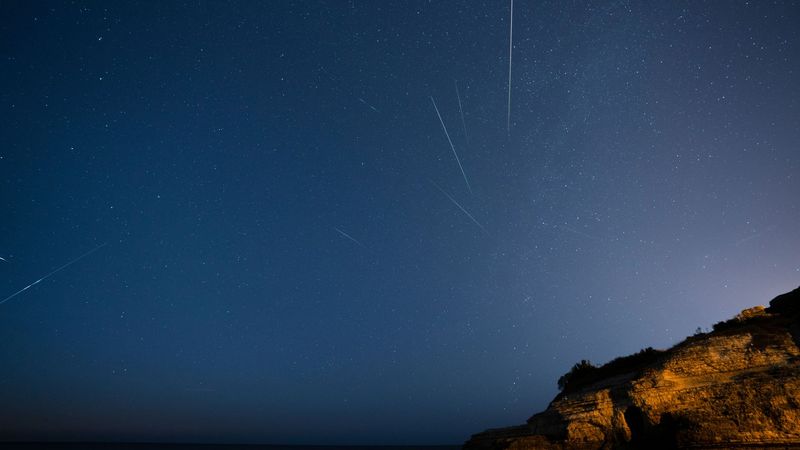
At a glance, the ISS looks like a very bright point of light moving smoothly in a straight-looking path. It does not blink like a typical airplane, and it does not make sudden turns. NASA describes it as moving far faster than aircraft: roughly 17,500 miles per hour in orbit. From the ground, however, its great distance makes that speed look like a calm, steady sweep from one side of the sky toward another.
Planets can be bright, but they hold their position relative to nearby stars over the minutes you are watching. A satellite may look similar to the ISS, but many are dimmer, and few are as conspicuous during a favorable pass. Aircraft usually reveal themselves through blinking navigation lights, multiple lamps, or a changing direction. The ISS is usually a single, unwavering light.
Brightness varies. Its apparent brightness depends on the angle between the Sun, the station, and you, as well as on the height of the pass. Do not assume a less spectacular pass was a failed one: haze, light pollution, a low elevation, and geometry can all make a genuine sighting subtler.
Set up a simple viewing spot
A backyard, sidewalk, park, or balcony can work well. The best site is not necessarily the darkest one; it is the one with an open view toward the part of the sky in the forecast. Avoid standing directly beneath a streetlight, and move a few steps away from bright windows or car headlights if you can. Give your eyes several minutes to adapt before the predicted start time.
You do not need binoculars, and they can make the task harder. The ISS moves quickly enough that a narrow field of view is difficult to keep aligned by hand. Naked-eye viewing lets you take in the whole route. If you bring children or friends, point out a landmark or compass direction beforehand, then ask everyone to watch that portion of the sky quietly as the pass begins.
Cloud cover is the obvious obstacle, but clear conditions do not guarantee a view. A low pass can be lost in ground haze, and a forecast may begin behind buildings or trees. Build in a margin by arriving outside five to 10 minutes early and selecting a location with more sky than you think you need.
- Check the forecast again shortly before going out.
- Arrive early enough for your eyes to adapt.
- Keep a clear line of sight toward the listed appearance direction.
A phone can help without taking over
NASA’s Spot the Station app offers alerts, real-time tracking, and an augmented-reality feature intended to help users visualize the station’s path. These tools are particularly helpful on a first attempt, when translating “34 degrees above ENE” into a real part of the sky can feel awkward. The app can also reduce the temptation to rely on generic social-media posts that may not match your exact location.
Still, use the device as preparation rather than as the main event. A bright screen reduces dark adaptation, and holding it up can keep you from noticing the station arrive. Check the time and direction, dim the display, and look up. If you use augmented reality, remember that phone sensors and location accuracy can introduce small errors; the feature is a guide, while the actual sky remains the final reference.
Try a photograph after you have seen it once
The most reliable first goal is simply to watch the station. Once you know its pace and appearance, photography becomes more rewarding. A tripod, a wide view, and a several-second exposure can turn the moving point into a clean line against the stars or twilight sky. The result will depend on the camera, lens, local light pollution, and the station’s route, so experimentation matters more than a single universal setting.
Avoid aiming at the station through a telescope unless you have specialized tracking equipment. At orbital speed, it crosses the field of view too rapidly for ordinary manual observing. A wide phone or camera composition that includes a recognizable foreground—trees, a roofline, or a landscape—is often both easier and more meaningful. Check local rules before setting up on private property, in parks after closing, or near roads.
- Use a tripod or stable surface if available.
- Compose wide enough to include the predicted path.
- Keep expectations flexible: clouds and brightness vary from pass to pass.
Final thoughts
A successful ISS sighting is less about advanced astronomy than about matching a reliable forecast to a clear patch of sky. Check the time, learn the appearance direction, choose a pass that rises high above the horizon, and look up a little early.
The payoff is unusually direct: a human-made research laboratory, carrying out work in microgravity, briefly becomes visible without any optical equipment at all. If one pass is clouded out or too low to see, another opportunity will come. The practical skill is learning to read the next one.
Sources
Photo by Markus Partoll on Pexels.