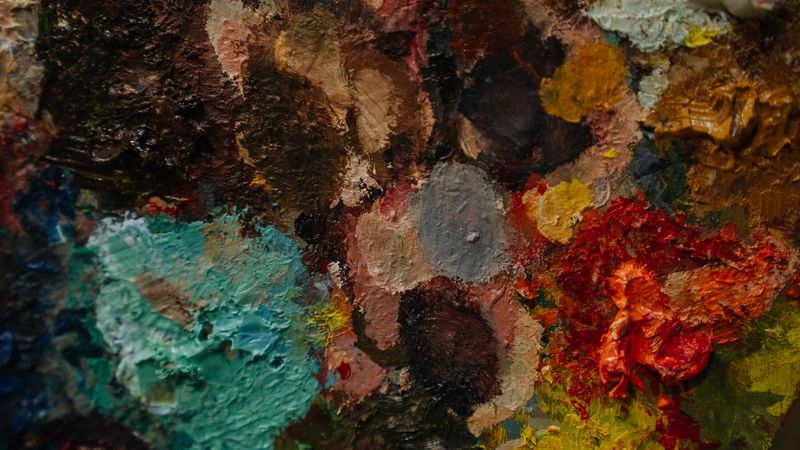
A painting can look settled even when its making was anything but. A figure’s hand may have been moved, a dog may once have faced another direction, or a carefully balanced composition may have begun as a loose network of marks beneath the visible surface. Those earlier choices usually disappear under layers of paint—not because they are unimportant, but because a finished picture is designed to present one resolved image.
Infrared imaging has changed how conservators and art historians approach that apparent finality. By recording reflected infrared radiation rather than visible light, it can sometimes reveal carbon-rich drawing materials, alterations, and paint stages that the eye cannot see. The result is not an X-ray vision of art, nor a shortcut to an artist’s private intentions. It is a carefully interpreted kind of evidence that makes the physical history of a painting more available.
A painting is built in layers
Many paintings begin with a support—such as wood panel, canvas, paper, or metal—followed by a preparatory ground. An artist may then sketch an underdrawing on that ground before applying paint. That drawing can establish the placement of figures, architecture, shadows, and major contours. In other cases, an artist begins with underpainting: broad painted passages that organize light, dark, color, or form rather than a line-based design.
These stages matter because they separate planning from execution without pretending that either was fixed. A ruled grid may indicate that a composition was transferred from a preparatory design. Free, repeated strokes may suggest that the artist worked out a form directly on the support. A visible correction, often called a pentimento, can show that a decision changed during painting. The final surface is therefore only the last readable layer of a longer process.
Technical examination gives these buried stages a place in art history. It can connect a picture to a workshop practice, clarify how a version relates to another version, or explain an odd feature in the visible composition. Just as importantly, it can establish that no detectable change survives. That negative result is useful: it may support the idea that an artist planned a particular design closely before painting it.
- Underdrawing: a preparatory drawing made on a ground before paint is applied.
- Underpainting: an early paint layer used to block in form, value, or color.
- Pentimento: evidence of an artist changing the composition during its making.
- Overpaint or inpainting: later restoration additions, distinct from the original artist’s paint.
What infrared reflectography actually detects
Infrared reflectography, often abbreviated IRR, records how a work absorbs and reflects wavelengths beyond the visible spectrum. Different materials behave differently under that illumination. Carbon-based media—such as charcoal, black chalk, graphite, or some inks—often absorb infrared radiation and can appear dark in an infrared image. Some upper paint layers are comparatively transparent at particular infrared wavelengths, allowing the buried marks to become more legible.
This is why IRR is especially associated with underdrawings in paintings. It does not literally remove the paint digitally or expose every layer at once. Rather, it exploits contrasts among materials. If a dark drawing material lies under a paint layer that permits enough infrared radiation to pass through and return to the detector, the drawing may emerge. If either material behaves differently, the result may be faint, partial, or blank.
The image is typically assembled from many captures into a larger mosaic and compared with a color photograph of the painting. Conservators read it alongside direct visual examination, magnification, ultraviolet imaging, X-radiography, pigment analysis, treatment records, and the work’s historical context. Each method answers different questions because each responds to different physical properties.
- Infrared methods are non-destructive: they can examine a work without sampling or cutting into it.
- A strong dark line in an infrared image may be an underdrawing, but its material and position still need interpretation.
- An absent line is not proof that an artist made no preliminary design; the drawing may use a material IRR cannot distinguish, or paint may block the signal.
From hidden marks to working methods
The value of infrared imaging lies less in surprise than in comparison. A single altered contour can be interesting, but patterns across a picture—or across several related pictures—can reveal how an artist or workshop operated. Repeated grids and registration marks can point to transfer methods. Closely matched underdrawings can support the use of a shared cartoon or source design. Differences in line quality can help scholars distinguish a copied layout from freer adjustments made while painting.
Technical study of two versions of an early Netherlandish Adoration of the Magi at the Metropolitan Museum of Art, for example, found comparable liquid underdrawings and corresponding changes in both works. That evidence supported the conclusion that both paintings were based on the same transferred design. The point is not that infrared imaging independently proved every aspect of their relationship. Instead, it supplied physical evidence that became meaningful when considered with style, materials, and construction.
Infrared work can also reshape a familiar artist’s reputation for control or spontaneity. Research on Vermeer’s Woman Holding a Balance found an earlier position for the balance in an infrared image. Elsewhere, advanced infrared and chemical imaging has helped reveal broad, quickly applied stages under Vermeer’s famously smooth final surfaces. Such findings make technique more concrete: polished appearances can depend on provisional, energetic work below.
Other tools reveal different kinds of evidence
Because a painting is a stack of materials, no single imaging method can describe it completely. Ultraviolet examination is often helpful for locating varnishes and later retouching because some materials fluoresce differently. Raking light, cast across the surface at a low angle, can disclose raised brushwork, distortions, or texture. Microscopy can make the sequence and condition of surface layers clearer.
X-radiography works differently from IRR. X-rays register variation in an object’s ability to absorb or transmit X-radiation, so they can reveal aspects of structure, dense pigments, changes beneath the surface, and features such as nails or canvas weave. An alteration that is invisible in infrared may be apparent in an X-radiograph; an underdrawing visible in IRR may have little presence in an X-ray. The techniques are complementary rather than competing.
That combination also protects against overconfident stories. Conservators may see a line, determine whether it lies below or above a paint layer, compare it to a radiograph, inspect the surface at high magnification, and consult prior conservation documentation before describing it as an original choice. The best technical art history is not a hunt for secret messages. It is a disciplined effort to match claims to what the material evidence can support.
The limits are part of the lesson
Infrared images can look authoritative because they make an unseen feature visible. Yet they are not neutral photographs of the past. Results depend on the detector, wavelength range, lighting, resolution, image processing, the painting’s materials, and its condition. A later repainting campaign can complicate the view. So can a pigment that remains opaque to infrared radiation, a preparatory mark made in a less responsive material, or a canvas texture that interrupts a faint line.
Nor does an underdrawing provide direct access to intention. A correction may reflect an artist’s aesthetic judgment, a practical adjustment, a patron’s request, a studio assistant’s contribution, or a response to the changing demands of the picture. Inferences are strongest when several forms of evidence agree and when scholars state what remains uncertain.
For museum visitors, this restraint is part of the fascination. Infrared reflectography does not replace close looking at a painting’s color, brushwork, scale, and surface. It adds another way of looking: one that treats the artwork not only as an image to be seen, but also as an object that retains traces of decisions, revisions, and labor.
Final thoughts
Infrared imaging changes the questions a painting can answer. Instead of asking only what appears on the surface, viewers and researchers can ask how the composition arrived there, what alternatives were tried, and which parts of the work were planned, transferred, or revised.
The answers are necessarily incomplete. But when infrared evidence is paired with other conservation tools and careful historical interpretation, it gives finished paintings a richer dimension: not hidden content for its own sake, but a material record of art in the act of becoming.
Sources
Photo by Diogo Digital Art on Pexels.