Choosing between oil and acrylic is often described as a choice between an old medium and a modern one, or between slow and fast painting. That shorthand is useful, but it misses the more important point: drying changes the sequence of decisions an artist can make. It affects whether a brush mark can be softened, whether a color can be revised without disturbing what is below it, and whether a painting is built as a continuously adjusted surface or as a stack of distinct layers.
Oil paint and acrylic paint can both produce luminous color, thin stains, opaque passages, sharp geometry, and heavy texture. Neither medium automatically makes work more expressive or more durable. Their binders, however, become solid by different mechanisms. Those mechanisms give each paint a different “clock,” and that clock quietly shapes the look of the finished image. Understanding it makes familiar stylistic differences—soft atmospheric transitions in one painting, crisp layered edges in another—feel less mysterious.
The binder sets the tempo
Paint is more than colored powder. Pigment supplies color, while a binder surrounds and holds the particles together after application. In conventional artist’s oil paint, the binder is a drying oil, commonly linseed, walnut, or poppy oil. The word “drying” is slightly misleading: oil paint does not simply lose liquid into the air. Oxygen reacts with components of the oil, creating an increasingly cross-linked solid network. Touch-dry paint may therefore continue to change and cure well beyond the moment it no longer feels wet.
Waterborne acrylic paint begins as small acrylic-polymer particles dispersed in water. As water leaves the layer, those particles are pushed together and merge into a continuous film. A thin acrylic passage can become dry to the touch remarkably quickly; a thick layer still needs much longer for water and other volatile components to leave throughout its depth. Yet, in ordinary studio use, acrylic generally closes the window for wet blending far sooner than oil.
This is not a technical footnote. The open period—the time when wet paint can still be moved, merged, lifted, or reworked—defines what a painter can plausibly do in one sitting. Oil encourages adjustment within a passage. Acrylic encourages a rhythm of placing a mark, allowing it to set, then responding with the next layer.
A wet surface invites negotiation
Because oil paint stays workable comparatively long, an artist can place two colors beside one another and feather their boundary into a gradual change. A highlight can be pulled through a shadow; a contour can be softened, sharpened, then softened again. This does not mean every oil painting is blurry. A painter can make edges emphatic in oil. It means that hard and soft edges can remain decisions made late in the process, rather than commitments made minutes after paint is applied.
Slow drying also supports wet-into-wet painting, often called alla prima. In that approach, lower and upper strokes can physically mingle. The resulting surface may record hesitation, correction, or a rapid visual response to a sitter or landscape. Oil’s flexibility and range of optical effects helped make it an expansive painting medium long before modern acrylics existed.
But extended wetness has costs. A fresh passage can be accidentally contaminated by a neighboring color, pressed flat, or disturbed when a painter returns too soon. Thick oil layers can also develop drying problems when their surface solidifies while material beneath remains mobile. The medium gives time, but it also asks an artist to manage time.
Acrylic turns layering into a design tool
Acrylic’s quick surface drying makes it especially well suited to a different kind of construction: separate, visibly ordered layers. Once a thin passage has set, a painter can place an opaque shape over it with less risk of unintentionally mixing the two colors. That makes clean-edged forms, repeated stencils, graphic silhouettes, and rapid glazing sequences practical. It also supports a brisk process of covering, revising, and rebuilding.
David Hockney’s 1967 painting A Bigger Splash offers a useful example. Its sharply bounded planes—the pool, house, lawn, sky, and diving board—do not prove that acrylic is the only medium capable of such clarity. But fast-drying acrylic was well matched to the painting’s crisp architecture and bright California light. It allowed wet-on-dry applications that could preserve unblended color and deliberate edges.
Consider a simple studio scenario. A painter is making a poster-like city scene with a red bus crossing a pale blue sky. In acrylic, they can block in the blue, wait for the surface to set, and paint a saturated red shape on top without turning the boundary purple. In oil, they could obtain the same visual result, but would more likely need to plan the order carefully, wait between stages, or accept some controlled mixing at the edge. The material has not dictated the picture; it has changed the easiest route to it.
The mistaken equation of speed with simplicity
It is tempting to treat acrylic as the easy paint because it can be thinned with water and seems to dry almost immediately. That overlooks its own demands. Acrylic can form a dry-feeling skin while thicker material below is still drying. Temperature, humidity, airflow, layer thickness, absorbency of the support, and the particular formulation all influence the result. A heat source or strong airflow may accelerate surface change without necessarily producing an ideal film.
Acrylic also does not have only one handling character. Heavy-body paints hold marks and peaks; fluid formulations pour or level; gels and pastes alter transparency, texture, and thickness. Retarders and wet palettes can extend working time. These tools make acrylic more adaptable, but they do not turn it into oil. A delayed acrylic blend still behaves within a water-evaporation system rather than an oil film that stays open for days.
Oil is equally variable. Pigments, oil type, additives, paint thickness, and environmental conditions can change drying behavior. Some pigments and metal-containing compounds can speed oil’s polymerization. That variation is one reason artists should resist universal timing rules such as “oil takes exactly three days” or “acrylic is cured overnight.” Paint labels and technical guidance for the exact materials matter more than medium-wide folklore.
What happens after the studio matters
The contrast also continues after a painting leaves the easel. Oil and acrylic do not simply become inert once they look finished. Getty conservation research notes that acrylic, alkyd, and oil-based paints can remain on very different curing timescales, while their mechanical properties depend on composition, manufacturing, and aging. A painting is an object made of interacting materials, not a fixed image floating above its support.
Acrylic’s flexibility can reduce some cracking risks, but its surface presents other conservation challenges. Smithsonian guidance explains that acrylic films are comparatively soft at ordinary room temperatures, can attract dust through electrostatic charge, and may incorporate grime into the surface over time. Cleaning and varnishing can be difficult because solvents or water can affect the paint layer or its additives. In other words, a contemporary acrylic painting may look tough because it is plastic-like, yet its surface can be unusually vulnerable to handling and dirt.
Oil paintings bring a different set of long-term concerns: yellowing, embrittlement, cracking, and complicated interactions among pigments, binders, grounds, and varnishes. It would be wrong to summarize this as “acrylic lasts” and “oil decays.” Both media can endure, and both can fail. Quality of materials, layer structure, artist technique, and storage conditions matter profoundly.
The trade-off is not merely slow versus fast
The practical choice is better framed as a choice of feedback loop. Oil lets the artist keep negotiating a passage: colors can merge, edges can migrate, and the whole image can remain provisional for longer. Acrylic lets the artist establish states quickly: a decision can be locked in, covered, or used as a stable platform for the next decision. One medium favors continuity; the other favors segmentation.
That distinction helps explain why artists sometimes combine approaches. An acrylic underpainting can quickly establish value, composition, or broad color relationships before slower oil passages are added later—provided the acrylic layer is properly dry and the materials are used according to manufacturer guidance. Other painters use acrylic exclusively but work in many transparent and opaque layers, gaining depth through accumulation rather than prolonged wet blending.
The best question is therefore not, “Which paint is better?” It is, “When do I need the image to remain changeable?” A portrait that depends on gradual modeling and constantly adjusted flesh tones may reward oil’s extended openness. A painting organized around masks, flat color, repeated revisions, or precise shapes may benefit from acrylic’s fast-setting layers. The medium is part of the painter’s thinking system.
- Choose oil when sustained wet blending, soft transitions, and long reconsideration are central to the process.
- Choose acrylic when rapid layering, clean separation of shapes, and fast revision between layers are central.
- Treat “dry to the touch” and “fully cured” as different stages, especially for thick applications.
- For either medium, do not assume a beautiful surface is automatically a stable one; follow product-specific instructions and avoid improvising with incompatible additives.
A useful way to look at finished paintings
Viewers often describe a painting’s mood as if it arose solely from subject matter: a pool seems bright, a portrait seems intimate, a landscape seems hazy. Material timing is often part of the explanation. A clear-edged image can reflect a process in which layers were allowed to remain separate. A smoky transition can reflect a process in which colors stayed physically available to one another.
That is not a rigid rule. Skilled painters regularly work against a medium’s defaults, and historical techniques are full of exceptions. Acrylic can be softened; oil can be hard-edged. Still, recognizing the difference between evaporation-driven film formation and oxygen-driven oil curing gives viewers a stronger account of what they see. It replaces the vague idea that artists simply “prefer a feel” with a more concrete understanding: paint changes the timing of thought, and timing changes the image.
Final thoughts
Oil paint versus acrylic is ultimately a comparison between two ways a painted surface becomes available—or unavailable—for change. Oil prolongs the present tense of painting. Acrylic helps turn yesterday’s decision into a stable condition for today’s next move.
For artists, that distinction can guide material choice before a first mark is made. For viewers, it offers a new way to read surfaces: not just as color and composition, but as records of time, chemistry, and choices made while paint was still moving.
Sources
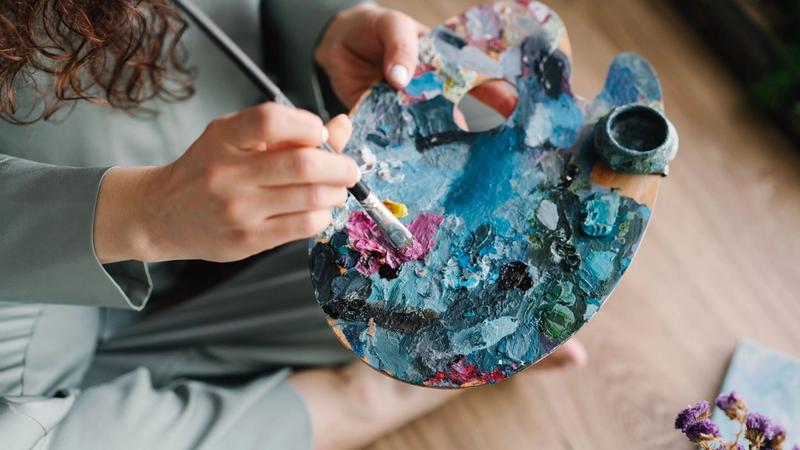
Photo by Huy Nguyễn on Pexels.