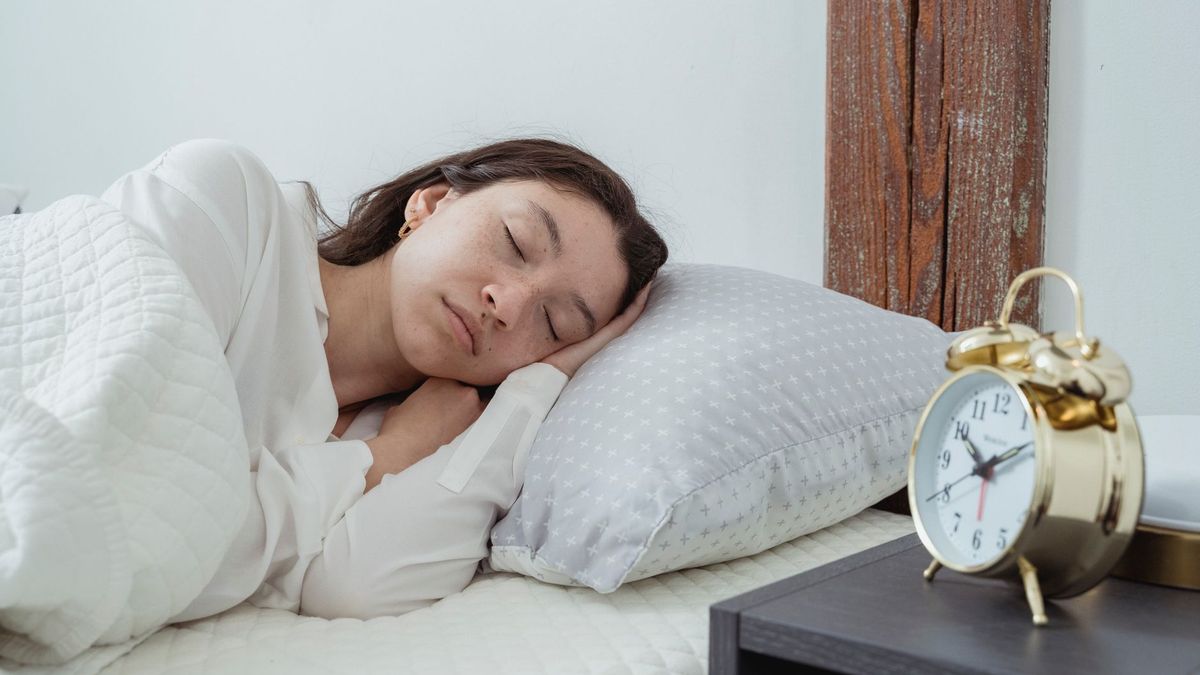
Sleep advice often begins and ends with a number: adults should get at least seven hours a night. That benchmark matters, but it leaves out another part of sleep health that is easy to overlook—the pattern of those hours. Going to bed at 11 p.m. on weekdays, 2 a.m. on Friday, and waking at radically different times across the weekend may produce enough total sleep on paper while still giving the body a shifting schedule.
Researchers call this sleep regularity: the consistency of when a person falls asleep and wakes up from one day to the next. It is not a demand for a perfectly controlled life. Rather, it recognizes that human biology runs on timing as well as quantity. A steadier routine can support alertness, make sleep easier to initiate, and help keep the body’s internal clocks aligned with daily life.
Sleep is governed by more than tiredness
Two systems shape when people sleep. The first is sleep pressure: the longer someone has been awake, the stronger the biological drive to sleep becomes. The second is the circadian system, a network of roughly 24-hour internal rhythms that helps coordinate sleep, alertness, hormone release, metabolism, and many other functions.
The brain’s central clock uses environmental cues to stay on time, with light and darkness especially influential. Morning light generally reinforces daytime alertness, while evening darkness helps signal that night is approaching. But the timing system is not confined to the brain. Nearly every tissue and organ has circadian rhythms of its own. That is why a large shift in sleep timing can feel more consequential than simply staying up late once: it changes the timetable against which many biological processes are organized.
This does not mean everyone should follow the same clock. Teenagers often naturally tend later than older adults, and some adults are earlier or later chronotypes. The useful goal is not to imitate a supposedly ideal bedtime. It is to make one’s own sleep and wake times reasonably predictable while still obtaining enough sleep.
What researchers mean by “regular” sleep
Sleep regularity is broader than a fixed bedtime. It includes the day-to-day consistency of both sleep onset and wake time, and in some research it also captures whether a person is asleep or awake at the same points on successive days. Wrist-worn motion sensors have made it possible to measure these patterns outside sleep laboratories.
A 2023 consensus statement from a panel convened by the National Sleep Foundation reviewed the available evidence and concluded that consistency in the timing of sleep onset and offset is important for health, safety, and performance. The panel also made an important distinction: when people are routinely short on sleep during workdays, extra weekend sleep may be beneficial. In other words, regularity should not be used to argue that someone must preserve an unhealthy sleep deficit for the sake of a schedule.
Regularity and duration are best viewed as complementary. A person who sleeps at consistent hours but only six hours most nights is still likely not meeting their sleep need. Conversely, someone who gets a long enough weekly average but repeatedly swings between very early and very late timing may be missing a different dimension of sleep health. For healthy adults, sleep experts generally recommend seven or more hours per night on a regular basis.
The evidence is promising, but it does not prove cause and effect
Large observational studies have linked irregular sleep patterns with less favorable long-term health outcomes. In one UK Biobank analysis that used accelerometer data from more than 60,000 participants, higher sleep regularity was associated with lower risks of all-cause, cancer, and cardiometabolic mortality during follow-up. Another study of older adults in the Multi-Ethnic Study of Atherosclerosis found that a pattern combining regular sleep with roughly seven hours of sleep was associated with lower mortality risk than an irregular, shorter-sleep pattern.
These findings are meaningful because they measured sleep patterns objectively rather than relying only on memory. They also adjusted for many differences among participants, including demographic, lifestyle, and health factors. Earlier NIH-supported research likewise found that people with the most irregular schedules had a higher likelihood of later cardiovascular events than people with more regular sleep.
Still, these are associations, not proof that changing a bedtime alone prevents disease or extends life. Health problems can disrupt sleep; irregular schedules can reflect shift work, caregiving, economic constraints, stress, pain, or untreated sleep disorders. The relationship may run in both directions, and factors that are difficult to fully measure can influence it. The practical takeaway is modest but useful: regularity is a plausible, low-risk component of healthy sleep, not a stand-alone cure or a guarantee of better health.
Why weekends can produce a “mini jet lag” feeling
A common pattern is to wake early under weekday obligations, then sleep much later on non-work days. This can provide needed recovery sleep, especially after a short week. But when the timing difference becomes large, Sunday night may feel strangely difficult: sleep pressure and the body clock are no longer pointing in the same direction as the Monday alarm.
People sometimes call this social jet lag because the mismatch resembles a smaller version of crossing time zones. The comparison is imperfect—there is no actual travel—but it captures the experience of living on one schedule during workdays and another on days off. The effect is often most obvious as grogginess, difficulty falling asleep at the desired hour, or a heavy reliance on caffeine to get through the morning.
The answer is not rigid perfection. A realistic approach is to preserve a dependable wake time more often than not and avoid turning every weekend into a wholesale schedule reversal. If extra sleep is needed, shifting both bedtime and wake time by a smaller amount may be easier on the next workday than sleeping far into the afternoon.
How to build more consistency without turning sleep into a project
A regular schedule works best when it is supported by cues that make biological sense. Light exposure, activity, meals, caffeine, and wind-down habits all help tell the body what part of the day it is. The National Heart, Lung, and Blood Institute notes that light is the strongest environmental signal for resetting the sleep-wake cycle; it also recommends regular routines, daytime physical activity, and attention to caffeine, alcohol, and nicotine near bedtime.
Start with the wake time, not an ambitious bedtime. Choose a morning time that fits most days and try to keep it within a manageable window. Then count backward to create enough opportunity for sleep. If sleep does not come easily at first, moving the schedule gradually—rather than forcing an abrupt two-hour change—may be more sustainable.
Morning daylight is another practical lever. A walk outside early in the day can strengthen the distinction between day and night, while dimmer light and less stimulating activity near bedtime can make the transition easier. These steps are not substitutes for medical care, but they are everyday ways to give the body clearer timing signals.
- Keep a wake-up time that is similar on workdays and days off whenever circumstances allow.
- Protect sleep duration first: regular six-hour nights are not the goal for most adults.
- Get outdoor light earlier in the day, particularly after waking.
- Create a repeatable pre-sleep routine, such as reading, stretching, or preparing for the next day.
- Avoid using a late weekend morning as the only solution to chronic weekday sleep loss; look for opportunities to increase sleep across the week.
- If rotating shifts, insomnia, loud snoring, breathing pauses, or persistent daytime sleepiness are part of the picture, discuss them with a qualified health professional.
Consistency is a useful target, not a moral test
Real lives include new babies, exams, night shifts, illness, travel, celebrations, and emergencies. An occasional late night does not erase a healthy routine, and people with nonstandard work schedules may have fewer options than conventional sleep advice assumes. The point is to reduce avoidable volatility where possible, not to treat every deviation as failure.
Thinking about sleep as a rhythm rather than a nightly score can be liberating. Instead of asking only, “Did I get eight hours?”, it adds two questions: “When did I sleep?” and “Was that timing broadly similar to yesterday?” For many people, that shift turns sleep hygiene from a collection of rules into something more intuitive: helping the body know when day begins, when night arrives, and when it can reliably rest.
Final thoughts
Sleep duration remains essential, and many adults need more of it. But the emerging research on regularity shows why a weekly average can conceal an unstable pattern. A reasonably consistent sleep-and-wake rhythm gives the circadian system clearer cues and may support health, functioning, and safety alongside adequate sleep.
The most practical first step is small: choose a wake time that works on most days, expose yourself to daylight after getting up, and make bedtime a gradual consequence of protecting enough sleep. Consistency is not perfection. It is a way of making rest easier for the body to recognize.
Sources
Photo by Miriam Alonso on Pexels.