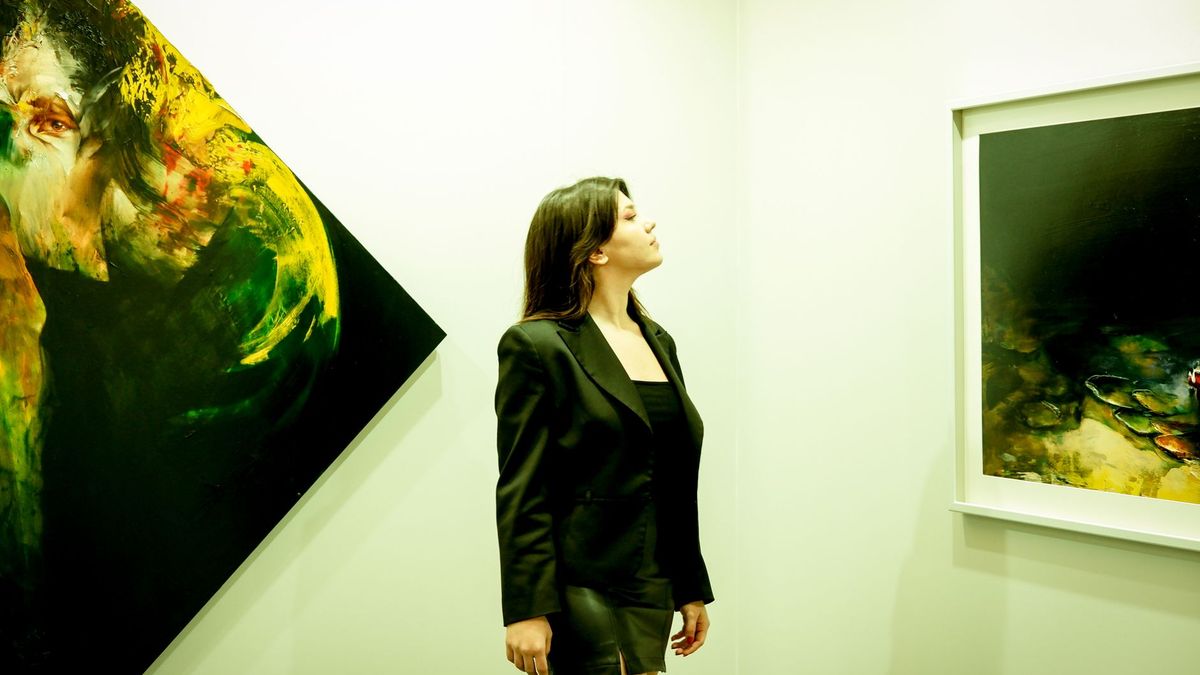
A museum visit often begins with an impossible ambition: see everything. Visitors move briskly from room to room, glance at a famous work, take a photo, read part of a label, and continue on. By the end, they may have covered a great deal of ground without feeling they have spent much time with any particular object.
A different approach has been gaining ground in museums and galleries: slow looking. The premise is simple. Choose fewer works, give them sustained attention, and let questions—not the pressure to be knowledgeable or comprehensive—shape the encounter. It is not a rejection of museum guides, historical context, or curatorial expertise. It is a way of making room for one’s own observations before outside information takes over.
A museum is not a checklist
The checklist approach makes sense. Major museums are enormous, travel time is limited, and visitors are often told which “masterpieces” they should not miss. Digital culture adds another incentive to keep moving: the artwork becomes a proof-of-visit image, quickly converted into a post, a camera-roll entry, or a pin on a map.
But cultural experiences do not always become richer when they are maximized. Artworks—especially paintings, photographs, textiles, sculpture, and decorative objects—often reveal themselves gradually. A distant view can establish an overall composition; a closer look may bring out a small gesture, a seam, a repair, an irregular brushstroke, or evidence of how a material was handled. Those details can change an initial interpretation.
Slow looking asks visitors to exchange coverage for contact. The National Museum of Asian Art describes it as devoting more time and attention to fewer objects, emphasizing quality rather than quantity. Its practical suggestion is modest: begin with three to five minutes, then extend the time as the practice feels more natural. That is a manageable intervention, not an afternoon-long test of patience.
- Instead of asking, “What am I supposed to know about this?”, begin with, “What is actually here?”
- Instead of trying to complete every gallery, choose a small number of works that hold your attention.
- Treat a return visit to the same room as a feature of the experience, not evidence that the first visit was incomplete.
Observation comes before interpretation
The first benefit of lingering is that it separates observation from conclusion. People commonly jump from a first impression to a verdict: beautiful, strange, boring, political, familiar. Those responses are valid starting points, but they can become more interesting when followed by a second question: what in the work produced that reaction?
Museum educators have developed straightforward prompts for this process. One widely used sequence is “See, Think, Wonder.” First, describe what can be noticed without needing to settle on its meaning. Next, consider possible interpretations. Finally, identify uncertainties or questions. The order matters. It makes room for ambiguity, while also asking viewers to connect interpretations to visible evidence.
This is not a demand that every viewer reach the same answer. In fact, the value of a gallery conversation often lies in discovering that other people noticed something different: an expression in a portrait, a repeated motif, an odd spatial relationship, or a technical choice that had been invisible at first. MoMA’s slow-looking materials similarly encourage visitors to track where attention goes, examine elements such as shape, color, line, and texture, and notice how their perception changes when they look again.
Labels and audio guides remain useful, but timing can transform their role. Reading a label after making a few observations means context arrives as a tool for testing, complicating, or expanding an idea. It is less likely to feel like an answer key handed over before the question has formed.
- Name colors, materials, scale, light, surface, gestures, and repeated forms.
- Ask what seems unusual, unresolved, hidden, or deliberately emphasized.
- Look from far away and nearby when gallery rules permit; sculpture especially changes with position.
- Read the label after an initial period of looking, then return to the work.
Drawing and description are tools for attention, not displays of talent
Slow looking can feel abstract until the body has something to do. That is why sketching and writing are common museum practices. The point is not to make a beautiful drawing or a polished review. A rough sketch forces the eye to decide where an edge begins, how a shape tilts, or which details repeat. In other words, it turns looking into an active process.
Description can work in the same way. Try writing five concrete things visible in an artwork, then five more after another minute. The second list is often less generic than the first. It may include the apparent thickness of paint, a reflected color, a cropped figure, the grain of wood, an empty area that suddenly seems important, or a relationship between two objects in the background.
These practices also loosen the assumption that art appreciation belongs only to people with formal training. The National Portrait Gallery’s slow-looking programs use clipboards, pencils, sketching, and writing exercises to help visitors investigate a single portrait. The underlying message is cultural as much as educational: expertise can deepen an encounter, but it is not a ticket required to begin one.
- Make a 60-second sketch of one corner rather than attempting the full artwork.
- Write a description without using evaluative words such as “good,” “bad,” or “weird.”
- Choose one detail and imagine the work without it. What story or mood would change?
- If visiting with someone else, compare notes before reading the label.
Slow looking should be inclusive, not prescriptive
It would be a mistake to turn slow looking into another rigid museum rule. Some visitors love moving rapidly through galleries and collecting visual impressions. Others may be visiting with children, navigating fatigue, working within a short time window, or encountering art in ways that do not depend on sustained visual attention. A good museum experience has more than one pace.
Accessibility work is an important reminder of this. The Smithsonian American Art Museum has developed visual descriptions for visitors who are blind or have low vision, challenging the old assumption that art can be fully appreciated only through sight. Carefully constructed descriptions draw attention to composition, material, scale, and spatial relationships. They show that close engagement is not simply about staring longer; it is about building pathways into an object through language, sound, memory, movement, and conversation.
Tate makes a related point in its guide to slow looking: the practice is not about being told the correct way to view art. It is an invitation to spend time with a work and notice what emerges. That framing matters. Slow looking is most useful when it gives viewers more agency, not when it makes them anxious that they are performing cultural appreciation incorrectly.
- Use benches, pauses, and gallery exits without guilt; physical comfort affects attention.
- Try audio description or discuss an artwork aloud to discover nonvisual and verbal routes into it.
- Let children choose an artwork rather than assigning only canonical highlights.
- Leave room for quick delight as well as extended attention.
A better way to remember a visit
The lasting memory of a museum trip is rarely a complete inventory. More often, it is a handful of encounters: a face in a portrait, the unnerving scale of a sculpture, a color combination, a pattern in a bowl, a scene that continued to raise questions afterward. Slow looking makes that outcome more likely because it allows an artwork to become specific.
On a future visit, try a deliberately small plan. Wander for a little while without trying to absorb every label. Choose one work that keeps calling you back. Give it five uninterrupted minutes. Describe what you see, then learn some context, then look once more. If nothing else, the exercise replaces the feeling of having raced through culture with the more satisfying feeling of having actually met something.
Final thoughts
Museums preserve vast collections, but no visitor is obliged to conquer them. Looking at less is not a failure of ambition. It is a decision to give art enough time to resist first impressions, invite questions, and become memorable.
In a culture built around speed, the most radical museum skill may be simple attention.
Sources
Photo by Beyzaa Yurtkuran on Pexels.